



*The colored areas of the map above represent parishes with currently known records for the given species (Source: Jeff Boundy, LA Dept. of Wildlife and Fisheries). By no means does it represent the full range of the species in the state, nor does it necessarily mean that a species can be found throughout the parish with the record. This is provided as a guide to where you might be able to find these species in the state and to aid in identification. A descriptive explanation of the range of each species can be found in the text below.
Other Common Names:
Subspecies: No subspecies recognized.
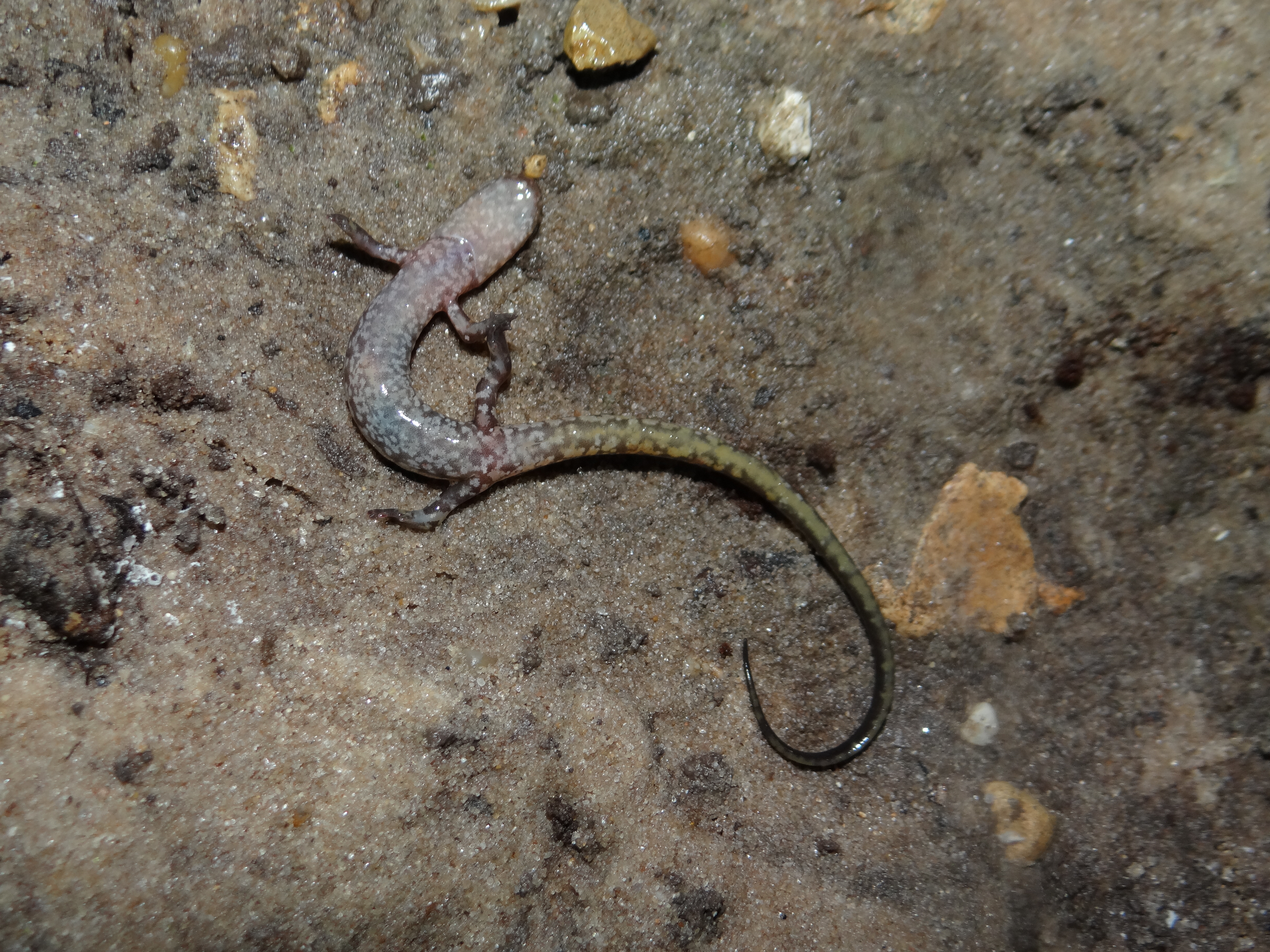
Adult Description: Slender, but long salamander (maximum 7.9”) with yellow to tan coloration on top of head, body, and top of tail. A dark brown or black line extends down middle of back from behind head to base of tail. Thicker dark brown or black lines run length of body and tail on each side, with lighter markings often on dark stripes on tail. Dark spots or markings are usually present on top of head. Lower sides are white or yellow with darker markings usually present. Tail becomes more laterally compressed towards tip. Tail makes up nearly two-thirds of body length. 13–14 costal grooves. Belly is pale to yellow with few to many gray markings.
Similar Species:
Species Range: Southeastern United States east of Mississippi River from west Tennessee south to Louisiana, east to Florida Panhandle, and north to Virginia.
Louisiana Range: Florida Parishes.
Adult Habitat: Forested uplands and lowlands, usually near spring-fed streams or seeps, but sometimes along swamp margins.
Natural History: Three-lined Salamanders are surface-active at night, spending the day concealed under surface cover objects, but retreating further underground in dry and cold extremes. They prey upon a wide variety of invertebrates. Predators of Three-lined Salamanders have not been reported, but likely include snakes, small mammals, and larger salamanders. Eggs of wild females have rarely been reported, but from limited observations females deposit small clumps of 8–14 eggs, usually attached to cover objects, in late fall and early winter. Multiple clumps are likely laid, but total clutch size is unknown. It is believed that females do not guard their nests. Time to egg hatching has not been reported, but likely takes 1–3 months. Larvae metamorphose in 4–6 months. Age at maturity is 2 years. Maximum wild longevity is unknown but believed to be over 10 years.
Best Time and Place to Observe: Three-lined Salamanders can be found year-round by uncovering objects, like rocks or logs in appropriate habitat. They are also often found within and under piles of woody debris and leaves left by receding water.
Global Conservation Status: Three-lined Salamanders have a relatively wide distribution in the southeastern United States and a presumed large population, and thus, are listed as Least Concern by the IUCN Red List. Their NatureServe Global Conservation Status Rank is G5 (Secure).
Federal Conservation Status: None.
Louisiana Conservation Status: Three-lined Salamanders have a ranking of S3 (rare and local throughout the state – 21-100 known extant populations) in Louisiana.
*** If you live in the range of this species in Louisiana and believe you may have observed this species please let me know (take a picture if possible), as there may be more unknown populations in the state.***
Author's Remarks: I have found this species in West Feliciana, East Baton Rouge, St. Tammany, St. Helena, Tangipahoa, and Washington Parishes in Louisiana.
